-


Podcast: Download
Subscribe: RSS
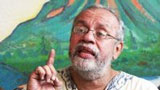
We get a majority world perspective on the climate emergency from Goldman Prize winner Ricardo Navarro. Navarro won the Goldman prize for sustainable development back in 1995 for his work as founder and director of the El Salvador Centre for Appropriate Technology and he is a former director of Friends of the Earth International.
Here he talks about how a new regional Movement of Climate Change Affected Peoples is responding to the pressures of climate change with awareness raising, permaculture techniques and low-level technologies as well as putting up resistance to inappropriate development. He also gives us his wider perspective on the United Nations climate talks which he has been attending since 1992.
-
Podcast: Download
Subscribe: RSS

With a new President in the White House there’s a fresh approach to climate change and energy policy in the US. But the Energy bill currently going through Congress is based on the widely-criticised “Cap & Trade” system and has been weakened further by a massive corporate lobbying campaign. How does this feed into the UN talks in Bonn in June which prepare the way for the critical meeting in Copenhagen in December? We get an informed critique of the Bill from Oscar Reyes of Carbon Trade Watch and ask him what to look out for in Bonn.
-
Podcast: Download
Subscribe: RSS
 The UN Climate Talks are at crisis point. Nothing on the table matches the scale of the challenge and corporate interests are rife. As the talks in Poznan come to an end, we take stock with three key protaganists: Kevin Smith (CarbonTradeWatch), Oliver Tickell (Kyoto2) and Tom Athanasiou (Greenhouse Development Rights).
Developments include:
- UNFCCC tenders a report on alternative frameworks
- 350 ppm CO2 target endorsed by Al Gore, AOSIS & the LDC country blocks
- Potsdam Institute shows how we can achieve the 350 ppm target
- Climate Justice Now! coalition grows in size from 20 to 160 organisations
- Carbon trading advances despite a crisis of credibility
- 142 organisations sign a statement against the World Bank’s involvement with climate funds
- The China+G77 block support climate funds being managed by UN
- Rich nations still failing to fulfill their commitments 16 years on
- Plans develop for a mass mobilisation in Copenhagen December 2009
- Could extending the scope of the Montreal Protocol and controling black soot be two effective ways forward outside the UNFCCC process?
-
Podcast: Download
Subscribe: RSS
 We continue our coverage of the UN Climate Talks in Poznan, Poland where the big issue on the table is “how to reduce emissions from deforestation”? The big push from investors is to incorporate forests into the carbon markets, but this approach is riddled with problems. Friends of the Earth International has warned that this would “create the climate regime’s biggest ever loophole.” We speak to Miguel Lovera, chair of the Global Forest Coalition about his concerns and his proposals for an alternative way forward.
Meanwhile in Brussels, European country delegates have been agreeing new targets for agrofuel for road transport. This will increase deforestation and emissions from other changes in land use. We speak to Robert Bailey of Oxfam International and ask why this disaster has been allowed to happen.
-
Podcast: Download
Subscribe: RSS
 In a special supplement to our usual weekly programme we give you an opportunity to hear another 40 minutes of our interview with Kyoto2 architect, Oliver Tickell.
We look at the Kyoto2 scheme in more detail and explore:
- What its effect on coal use would be
- Whether the scheme could work alongside national carbon rationing schemes (eg TEQs)
- Whether the scheme could emerge out of a combination of a reformed EU Emissions Trading Scheme and Barack Obama’s Cap and Trade System
- Whether it would create a market in carbon and if so how would that work
- What its effect on the economy would be
- How it would be policed
-
Podcast: Download
Subscribe: RSS
 As a result of a massive civil society campaign, the UK will soon pass historic legislation which will bind the government to reducing greenhouse gas emissions by 80% by 2050. However a major loophole remains which threatens the credibility of the Bill – there is no limit on the amount of international credits the UK can buy up in order to meet this target. Will this loophole be closed before the law is given Royal Assent?
Featuring:
- Eliot Whittington (Christian Aid)
- Martyn Williams (Friends of the Earth)
- Steve Webb MP (Liberal Democrats)
- Dr Alice Bows (Tyndall Centre)
It is clear that we need to display greater commitment to tackling climate domestically if we are to have a credible voice in international negotiations. The leadership demonstrated in the commissioning of the Stern Review and bringing forward the Climate Change Bill is in danger of being undermined by policies such as airport expansion plans or an over-reliance on international credits in meeting domestic emission reduction commitments – Environment Audit Committee, July 2008
We urge caution about the use of international carbon credits. The argument that a tonne of carbon reduced abroad is the same as a tonne of carbon reduced at home is an over-simplification of a complex issue. Permitting the use of too many international carbon credits will drive down the cost of carbon, but this will also make renewables and air pollution targets more expensive to reach and potentially slow down the long term shift to a low-carbon economy in the UK – Environment Audit Committee, July 2008
It looks like between one and two thirds of all the total CDM offsets do not represent actual emission cuts – David Victor, Stanford University
-
Podcast: Download
Subscribe: RSS
 A Bill Without Balls?
If the rest of the developed world followed the pathway envisaged in the United Kingdom’s Climate Change Bill, dangerous climate change would be inevitable – United Nations Development Programme
In June 2008 a press release by UK development charity Christian Aid announced that the government had “eviscerated” the Climate Change Bill – a potentially groundbreaking piece of legislation which will put greenhouse gas reduction targets into UK law. The UK government had announced its intention to remove key ammendments that have been made by the House of Lords.
We speak to Eliot Whittington, Christian Aid’s senior advisor on Climate Change and Sustainable Development, about their concerns and how they might be addressed. They include:
- an outdated target of 60% reduction in CO2 by 2050
- removal of a reference to the 2C global threshold
- shipping and aviation still not included
- no limit on the amount of carbon credits that can be bought to meet targets
- removal of an obligation on UK companies to disclose their carbon footrpint
-
Podcast: Download
Subscribe: RSS
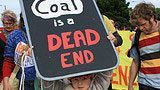 Despite James Hansen’s personal plea to Prime Minister Gordon Brown last December to take a leadership role in initiating a global moratorium against unabated coal, the UK government’s Department for Business currently looks likely to grant permission to a new series of coal-fired power stations that are “Carbon Capture Ready”. We discuss what this means and why it’s not good enough with Dr Keith Allott, Head of WWF-UK’s Climate Change Campaign who commissioned a report recently exploring these questions.
We requested an interview with the Department of Business but had to make do with a written statement which explains that the UK is relying on the highly problematic and inadequate EU Emissions Trading Scheme to solve the problem.
Meanwhile in the US, the tide is turning against coal at the grassroots, state and even the federal levels – 59 applications for coal-fired power plants were cancelled, abandoned or put on hold in 2007 and there is a bill going through Congress to put a moratorium on new unabated coal developments. We speak to Mike Ewall of the Energy Justice Network who has played a key role in supporting and connecting up the grassroots campaigners who have been doggedly winning on a case by case basis.
We close the programme with a taster from a landmark speech made by Al Gore last week, where he suggests the US should respond to climate change with the due urgency the science now implies. He lays down a “moon landing” style challenge for the US to power itself by renewable energy within just ten years.
-
Podcast: Download
Subscribe: RSS
EMISSIONS TRADING IN EUROPE
After last week’s interview with Soumitra Ghosh on the negative impacts of CDM projects in India, we conclude our look at carbon trading by speaking to the director of Climate Action Newtwork Europe, Matthias Duwe.
– What are Europe’s environmental NGOs doing to help reform the CDM?
– What is their view on the effectiveness of EU Emissions Trading Scheme as a way of cutting our greenhouse gas output? -
Podcast: Download
Subscribe: RSS
CARBON TRADING – ARE WE BEING CONNED?
Even though the United States administration decided not to ratify the Kyoto Protocol, the US left the treaty with a legacy of market-based “flexible mechanisms”.
In 2001 Mark Lynas wrote in The Guardian that these flexible mechanisms would lead to a net increase in emissions from industrialised countries, rather than a reduction of 5.2%.
As Larry Lohman’s authoritative critique on carbon traiding is published (see link below), The Two Degrees Show examines the record so far of the projects that are being funded under the Kyoto Protocol’s Clean Development Mechanism.
We speak to Soumitra Ghosh in West Bengal who has been documenting the impact of CDM projects in India. He found that projects are dispossessing people from their land, lowering water tables, and polluting water and air – resulting in lower crop yields and ill health.
We also speak to Kevin Smith of Carbon Trade Watch and ask whether the CDM is beyond reform and, if so, what should be done instead.